 LLMs can solve entirely new tasks in a zero-shot manner.
A ubiquitous emerging ability is, just as the name itself suggests,
that LLMs can perform entirely new tasks that they haven’t encountered
in training, which is called zero-shot. All it takes is some
instructions on how to solve the task.
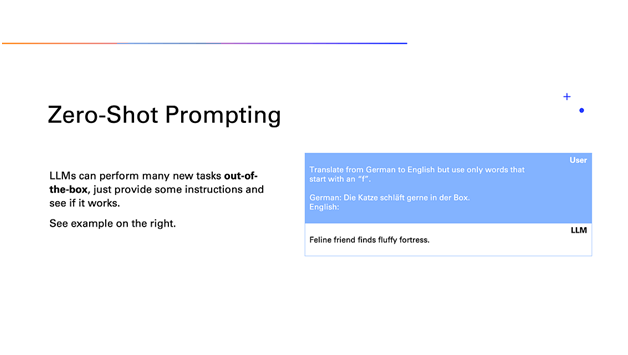
To illustrate this ability with a silly example, you can ask an LLM
to translate a sentence from German to English while responding only
with words that start with “f”.
For instance, when asked to translate a sentence using only words that
start with “f”, an LLM translated “Die Katzeschläft gerne in der Box”
(which is German and literally means “The cat likes to sleep in the box”)
with “Feline friend finds fluffy fortress”, which is a pretty cool
translation, I think.
 LLMs, just like humans, can benefit from providing them with examples
or demonstrations.
For more complex tasks, you may quickly realize that zero-shot prompting
often requires very detailed instructions, and even then, performance
is often far from perfect.
To make another connection to human intelligence, if someone tells you
to perform a new task, you would probably ask for some examples or
demonstrations of how the task is performed. LLMs can benefit from
the same.
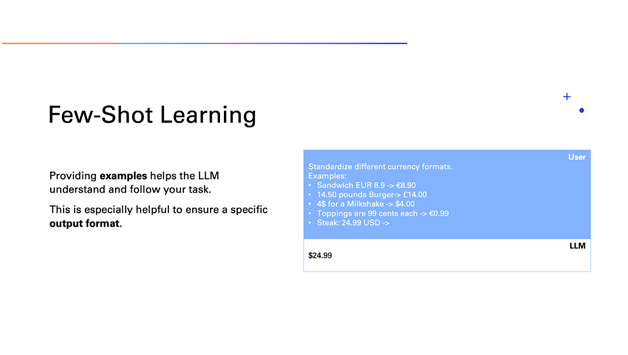
As an example, let’s say you want a model to translate different
currency amounts into a common format. You could describe what you want
in details or just give a brief instruction and some example
demonstrations. The image above shows a sample task.
Using this prompt, the model should do well on the last example,
which is “Steak: 24.99 USD”, and respond with $24.99.
Note how we simply left out the solution to the last example.
Remember that an LLM is still a text-completer at heart, so keep a
consistent structure. You should almost force the model to respond
with just what you want, as we did in the example above.
To summarize, a general tip is to provide some examples if the LLM is
struggling with the task in a zero-shot manner. You will find that
often helps the LLM understand the task, making the performance
typically better and more reliable.
 Chain-of-thought provides LLMs a working memory, which can improve
their performance substantially, especially on more complex tasks.
Another interesting ability of LLMs is also reminiscent of human
intelligence. It is especially useful if the task is more complex
and requires multiple steps of reasoning to solve.
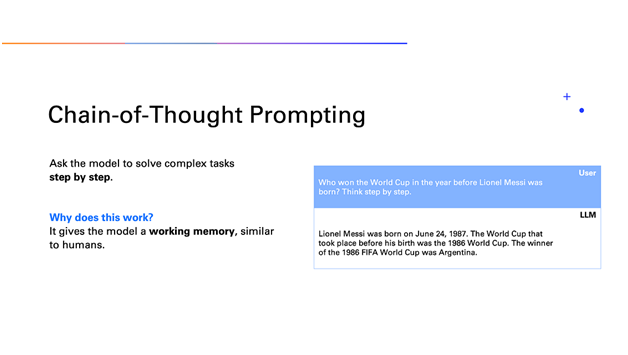
Let’s say I ask you “Who won the World Cup in the year before
Lionel Messi was born?” What would you do? You would probably solve
this step by step by writing down any intermediate solutions needed
in order to arrive at the correct answer. And that’s exactly what
LLMs can do too.
It has been found that simply telling an LLM to “think step by step”
can increase its performance substantially in many tasks.
Why does this work? We know everything we need to answer this.
The problem is that this kind of unusual composite knowledge is
probably not directly in the LLM’s internal memory. However, all
the individual facts might be, like Messi’s birthday, and the
winners of various World Cups.
Allowing the LLM to build up to the final answer helps because it
gives the model time to think out loud — a working memory so to say —
and to solve the simpler sub-problems before giving the final answer.
The key here is to remember that everything to the left of a
to-be-generated word is context that the model can rely on. So,
as shown in the image above, by the time the model says “Argentina”,
Messi’s birthday and the year of the World Cup we inquired about are
already in the LLM’s working memory, which makes it easier to answer
correctly.