How to Read an AI Job Description: Which Requirements Are Real and Which Are Copy-Paste
A job posting can demand five years of experience with a technology that became widely available only three years ago. It can also list 15 tools when the actual job requires four of them every week.
If you are moving from Salesforce, data engineering, QA, testing, or technical support into AI, learning to read job descriptions is a career skill. The goal is not to pretend you meet every requirement. It is to identify what the team genuinely needs and whether you can do the work.
1. Read a Realistic AI Engineer Posting Line by Line
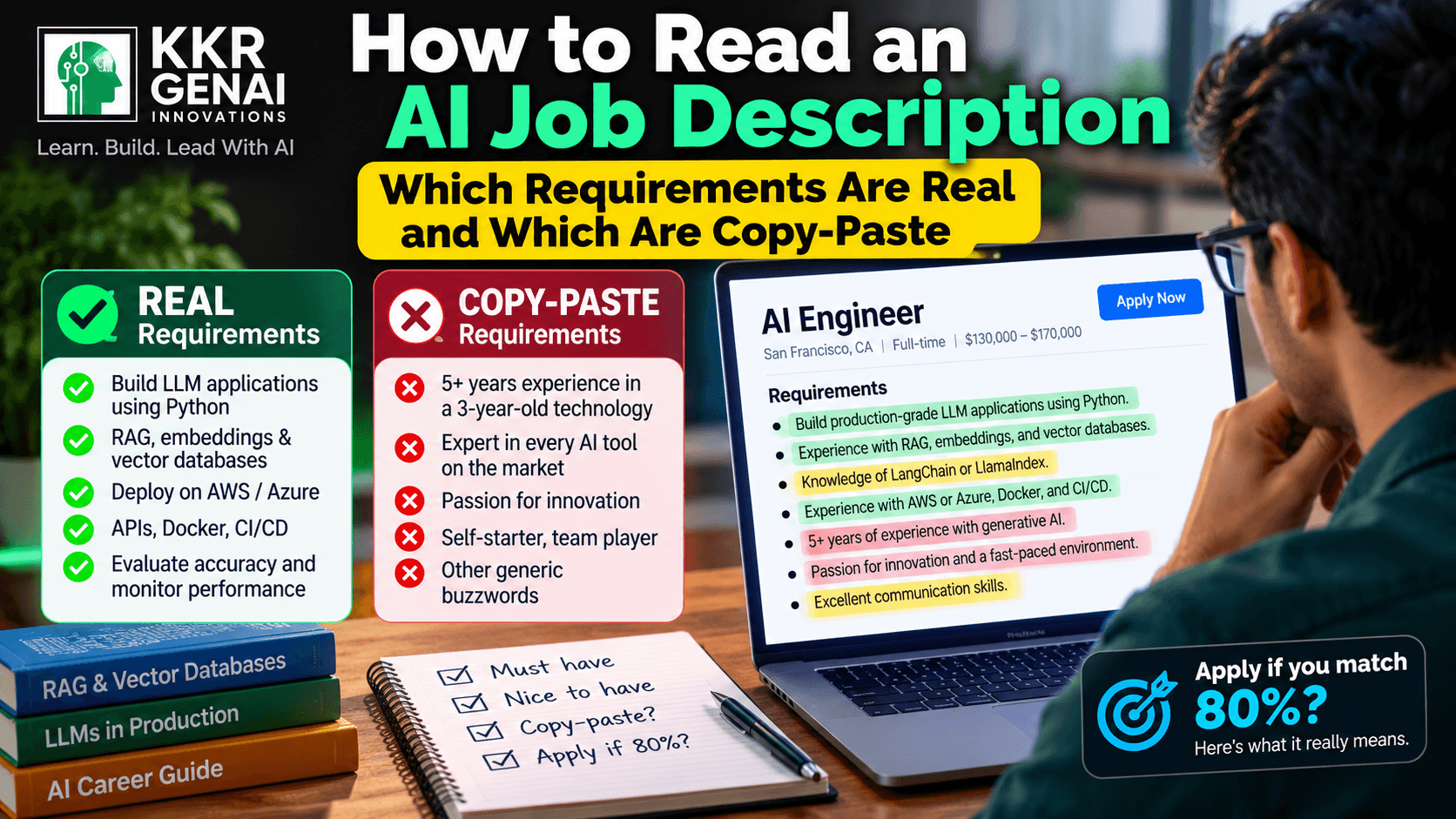
Imagine a US company advertising this position: AI Engineer, salary $130,000–$170,000, building internal AI assistants and document-search applications. Here are typical requirements and how to interpret them.
“Build production-grade LLM applications using Python.” This is a core requirement. Expect to write code, connect APIs, handle errors, and deploy applications. A few prompt-writing exercises will not be enough.
“Experience with RAG, embeddings, and vector databases.” Also important. Retrieval-augmented generation (RAG) lets an application retrieve relevant information before asking a model to answer. You should understand chunking, similarity search, metadata filtering, and how to test retrieval quality.
“Knowledge of LangChain or LlamaIndex.” Usually a tool preference, unless the posting describes an existing system built around one framework. Knowing one well and understanding the underlying concepts can be more useful than memorizing both.
“Experience with AWS or Azure, Docker, and CI/CD.” This signals that the team expects software that runs beyond a local demo. You may not need deep expertise in every cloud service, but you should understand deployment, environment variables, logs, and basic security.
“Excellent communication skills and a passion for innovation.” These are broad expectations, not evidence of specific technical competence. Communication matters, especially when working with business teams, but this line should not distract you from the actual engineering responsibilities.
2. Hard Requirements, Preferences, and the Five-Year Problem
Separate the posting into three groups: essential work skills, preferred tools, and general HR language. Essential skills usually appear in the responsibilities as well as the requirements, while optional skills often use phrases such as “nice to have,” “preferred,” or “familiarity with.”
Look for repetition. If Python, APIs, RAG, and production deployment appear throughout the posting, they probably matter. If a tool appears once in a long list of 20 technologies, it may be less important.
Now consider this requirement: “Five years of experience building applications with a technology released three years ago.” The wording may reflect a copied template, confusion between related technologies, or an employer's unrealistic expectations.
Check the dates and the surrounding context before dismissing it. The company might be counting earlier experience with machine learning, search, or cloud systems, rather than demanding five years with the exact product. If the timeline is genuinely impossible, ask the recruiter whether equivalent experience is acceptable.
Do not assume every awkward requirement is harmless boilerplate. A repeated, specific requirement tied to a core responsibility deserves attention, even if the job title sounds attractive.
3. What “Apply If You Match 80%” Actually Means
The 80% rule is a useful guideline, not a hiring statistic or a guarantee of an interview. It means you should not reject yourself simply because you lack one optional framework or cloud certification.
Suppose a posting lists Python, REST APIs, PostgreSQL, RAG, LangChain, AWS, Docker, Kubernetes, and model evaluation. You have Python, APIs, PostgreSQL, Docker, and testing experience, and you have built a working RAG project, but you have not used Kubernetes professionally.
You may be a reasonable applicant if the role emphasizes application development and Kubernetes is only preferred. You may be a poor fit if the job requires operating a large Kubernetes-based AI platform independently from day one.
Instead of counting keywords, classify each requirement as “can do,” “can demonstrate in a project,” or “cannot do yet.” Prioritize the first two categories, then investigate the third. A portfolio showing a deployed chatbot with source citations, error handling, and evaluation results can demonstrate skills that a list of completed courses cannot.
4. Three Signs of a Serious AI Team—and Three Warning Signs
Positive signal 1: Specific production responsibilities. Phrases such as “measure retrieval precision,” “reduce inference latency,” or “monitor token costs” suggest the team understands real AI system problems.
Positive signal 2: Defined data and evaluation practices. A posting that mentions access controls, evaluation datasets, hallucination testing, monitoring, or human review gives you clues about how the company intends to measure quality.
Positive signal 3: A clear technical environment. Named systems such as PostgreSQL with pgvector, FastAPI, Docker, AWS Bedrock, or Azure AI Foundry help you understand what you would actually build. Specific tools alone do not prove a mature team, but clear responsibilities are encouraging.
Now watch for three warning signs. First, the company demands expertise in every popular AI framework without explaining the work. Second, it promises fully autonomous AI that never makes mistakes, with no mention of evaluation or human oversight. Third, it combines research, full-stack development, DevOps, data engineering, and enterprise architecture into one junior role without defining priorities.
These signs do not automatically mean the employer is bad. They mean you should ask better questions about team size, technical leadership, success measures, and the first 90 days of the job.
5. Turn the Job Description Into a Learning Plan
If you come from Salesforce, build an AI feature that retrieves approved CRM information through secure APIs. If you work in data engineering, build a document-ingestion and retrieval pipeline using Python, PostgreSQL, and pgvector.
QA professionals can demonstrate automated evaluation with 30–50 test questions, checking answer accuracy, source relevance, and failures. Support professionals can build a troubleshooting assistant that retrieves verified documentation and escalates questions it cannot answer reliably.
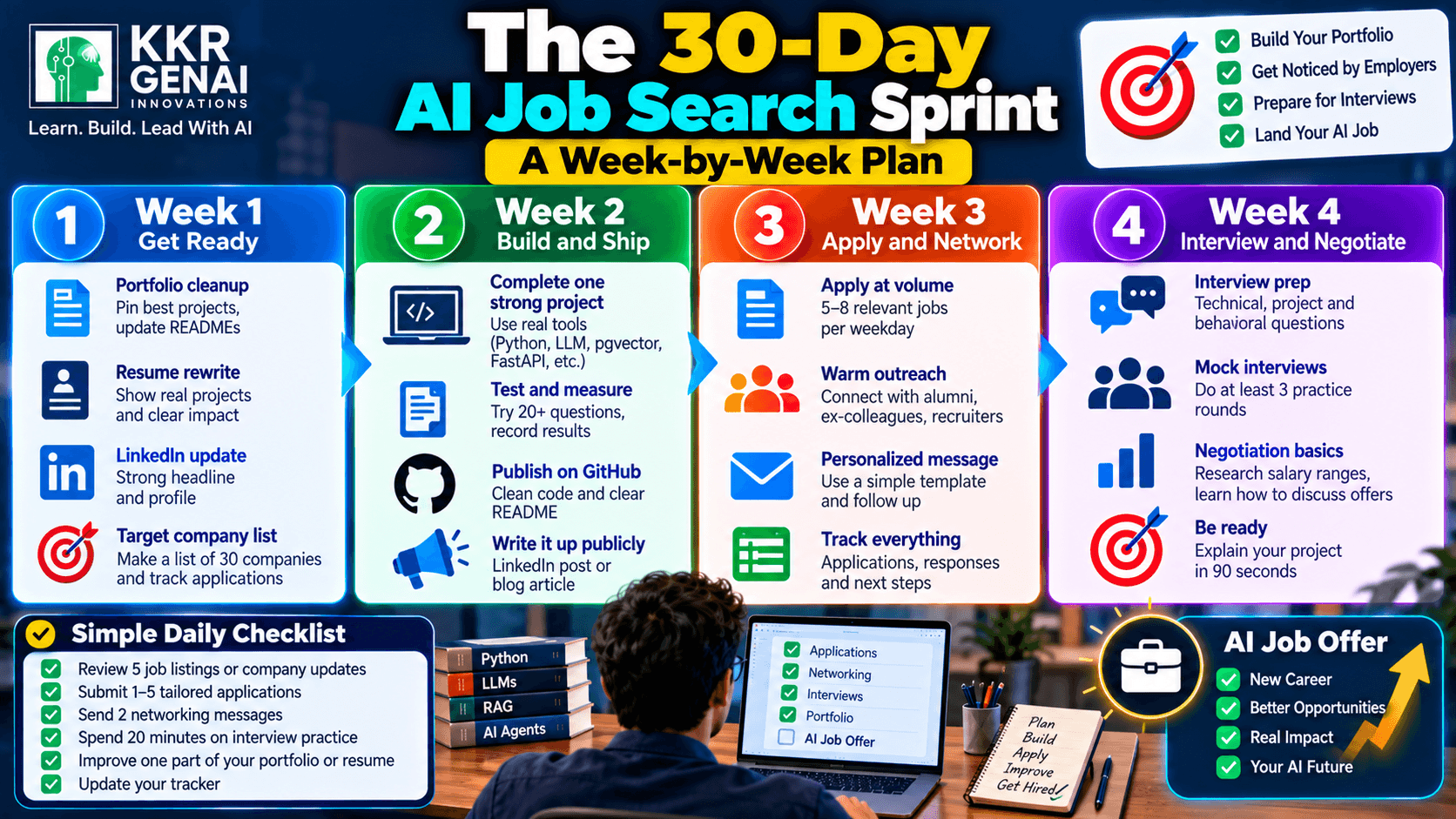
Pick one target job, review five similar postings, and identify the skills that appear repeatedly. Spend your learning time on those skills, build a project that proves them, and tailor your resume to the responsibilities you can genuinely demonstrate.
Paste a job description you are unsure about in the comments — which line is stopping you from applying?
Join the KKRGENAI Innovations community discussion to compare job descriptions, share learning strategies, and help other professionals make their next move into AI.