Portfolio Beats Resume: What a Hiring Manager Clicks in the First 10 Seconds
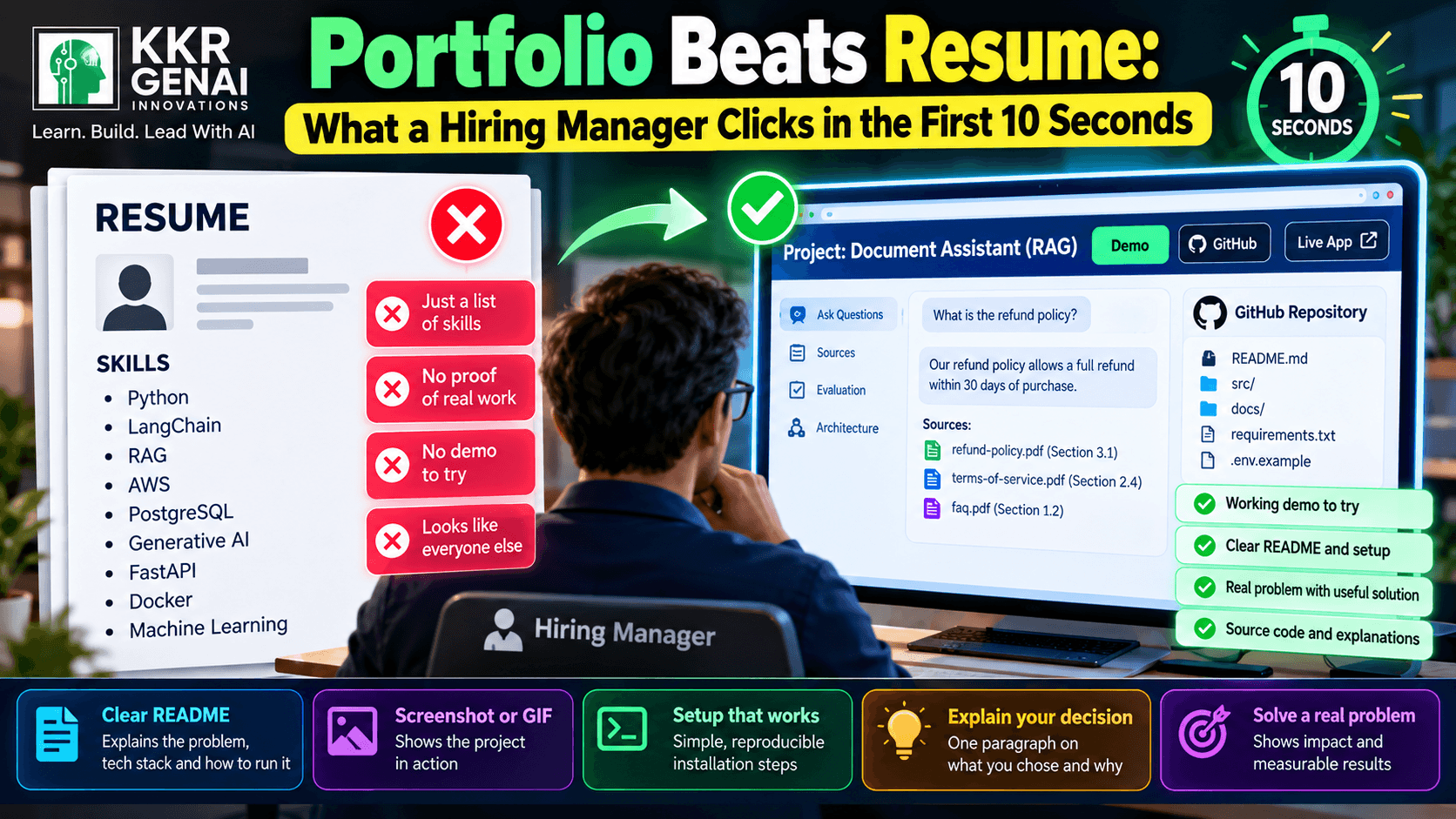
A resume can claim Python, RAG, LangChain, and AWS in a single line. A working demo can show whether you actually know how to build something with them.
When applying for AI engineering roles, your portfolio gives hiring managers evidence that a skills list cannot. You do not need ten projects; you need a few useful projects that work, solve real problems, and are easy to evaluate.
1. Why a Working Demo Beats a List of Skills
Imagine two candidates applying for an AI Engineer position. Both list Python, PostgreSQL, and generative AI on their resumes, but one provides a link to a deployed document-search assistant with source citations and the other provides only course certificates.
The demo gives the hiring manager something concrete to inspect. They can ask a question, examine the answer, check whether the sources support it, and see how the application behaves when information is missing.
A good demo does not need thousands of users or an expensive infrastructure setup. A small application that works consistently, explains its limitations, and handles errors can be more convincing than a complicated project that fails during setup.
Make the first click easy. Put your live demo, GitHub repository, and a short explanation of the project's purpose near the top of your portfolio page. If the application requires an API key, provide a safe demo mode or clear setup instructions without exposing credentials.
2. Anatomy of a GitHub Repository Worth Opening
Your repository should help someone understand the project before they read every line of code. A hiring manager may have several applications to review, so remove unnecessary friction.
Start with a useful README.md. Explain the problem, who the application helps, the main features, the technology stack, and how to run it. Include a short architecture diagram if the application has several components, such as a React frontend, FastAPI backend, and PostgreSQL database.
Add a screenshot or GIF. Show the application running, not just a collection of code files. A 10–20 second GIF can demonstrate a user asking a question, the system retrieving information, and the final answer displaying its sources.
Make setup reproducible. Include a requirements.txt or pyproject.toml for Python, a package.json for Node.js, an .env.example with placeholder values, and clear installation commands. Never commit API keys, passwords, private customer records, or production configuration.
Explain one engineering decision. Add a short paragraph describing why you chose a particular approach. For example: “I used PostgreSQL with pgvector instead of a separate vector database because the application already stored its business data in PostgreSQL, reducing operational complexity.”
Finally, include basic tests and known limitations. Even five meaningful tests are more useful than claiming the application is production-ready without evidence. If possible, provide a simple evaluation table showing results across 30–50 representative questions.
3. Three Projects Worth Building—and Three to Avoid Repeating
Build 1: A document assistant with citations. Use Python, FastAPI, PostgreSQL with pgvector, and an LLM API to answer questions from a small set of documents. Measure retrieval quality and answer accuracy, and show what happens when the answer is not in the documents.
Build 2: An AI workflow with tools. Create an assistant that calls a mock CRM API, validates the returned data, and drafts a support response. Include permission checks, error handling, and a confirmation step before any consequential action.
Build 3: An AI evaluation dashboard. Compare two prompts, models, or retrieval configurations against 50 test questions. Report accuracy, latency, token usage, and estimated cost so the project demonstrates measurement rather than just generation.
Three projects are also becoming difficult to distinguish: a basic chatbot that only forwards messages to an API, a PDF summarizer with no evaluation or source verification, and a generic AI image or text generator with a standard interface.
These are not useless beginner exercises. They become weak portfolio pieces when they stop at the tutorial stage. Improve one by adding a specific user problem, reliable data handling, evaluation, deployment, or a thoughtful design decision.
4. Turn Your Existing IT Experience Into an Advantage
You do not have to build a project unrelated to your previous career. Your existing domain knowledge can help you create something more realistic than a generic demonstration.
Salesforce developers can build an assistant that retrieves approved CRM information and summarizes account activity. Data engineers can build a document-ingestion pipeline with metadata filtering and reliable updates, while QA professionals can create an evaluation suite that tests hallucinations, missing sources, and inconsistent answers.
Support professionals can build a troubleshooting assistant that searches verified knowledge articles and escalates unresolved questions. In each case, explain what problem you solved, what you measured, and what you would improve next.
5. Write a Resume Line That Earns the Click
A weak project bullet describes activity: “Built a chatbot using Python and LangChain.” It tells the reader which tools you touched, but not what the application does or whether you evaluated it.
A stronger version might read: “Built a Python RAG assistant using FastAPI and PostgreSQL/pgvector to answer questions from 40 policy documents, returning source citations and testing retrieval quality across 50 questions.” Only include numbers and results you actually achieved.
Use this simple formula: what you built, which technical approach you used, what problem it solved, and how you measured it. Link the project name directly to the live demo or repository so the reviewer can verify the claim without searching for it.
Before applying, open your portfolio on a phone, test every link, follow your own setup instructions on a clean environment, and remove anything that no longer works. A small, finished project with clear evidence is a stronger signal than a long list of unfinished experiments.
What is the one project you would put at the top of your portfolio today?
Join the KKRGENAI Innovations community discussion to share your portfolio, exchange project ideas, and get feedback from other professionals building their AI careers.