We mainly focus on how transformers work in detail and determine how they are able to generate text based on attention mechanisms and how they can power ChatGPT.

With the phenomenal hit of generative AI applications with one of the most prominent being ChatGPT, there is a lot of interest and speculation in this field of artificial intelligence and deep learning. There are newer and better applications being developed by the likes of Google and Microsoft (most of you might be familiar) and other companies racing in this field, it can be of great use to learn the underlying architecture and the overall basic building blocks about the architectures that power ChatGPT: Transformers.
While OpenAI can be using modified versions of transformers along with reinforcement learning, getting to understand the basics of transformers can help one to gain a good understanding about the overall picture of generative AI applications and also aid readers in the process of discovering new innovations in the field. In this article, we can be mainly focusing on the working of transformers and the important equations that lead to self-attention and how encoder-decoder networks interact in order to generate text based on various prompts given by the user.
In the past before the discovery of transformers, sequence-to-sequence modeling was performed (slow) with networks such as LSTMs, GRUs and RNNs. While they do a good job in capturing the structure of a given text (looking at the past to determine the next set of words), training large volumes of text can be time consuming due to their nature of processing text sequentially. In addition to this, they often suffer from vanishing gradient problem when they encounter texts that are too long. As a result, they fail to capture important information from the past text that is too long and beyond their reach.
It was because of these limitations that there was a good amount of research for better architectures that resulted in state-of-the-art results in language modeling tasks such as text summarization, sentence classification and others. After the discovery of transformers, they revolutionized the natural language processing industry. However, their true potential was not yet realized beyond the NLP and deep learning community. It was with the invention of ChatGPT that a large number of people showed growing interest to learn about the underlying architectures and their functioning.
We will now take a look at a few blocks of code and understand the working of transformers along with a few examples to further gain intuition about the inner workings of the transformer model.
Note that this is a basic implementation of transformers with blocks that may not represent the true model used by OpenAI. However, it can give a good idea and a general understanding of their working in detail.
We can divide the coding into a few sections to help us better understand the dependencies between various components that make up a transformer in detail.
Multi-Headed Attention
This is one of the important components in a transformer. In this method, we define a set of weights namely k, q and v which stand for key, query and value. These are multiplied separately with the text embedding and multiple such layers are formed to give rise to attention. In order words, these variables compute the attention that must be captured for all the previous words in a sentence based on the present word.
“It is generally hot when it is sunny.”
In this sentence, if we were to remove the word “sunny” and ask the transformer model to make prediction of the words that could be present in that space, it would mostly give attention to word “hot” and “when” to make a prediction about the word “sunny”.
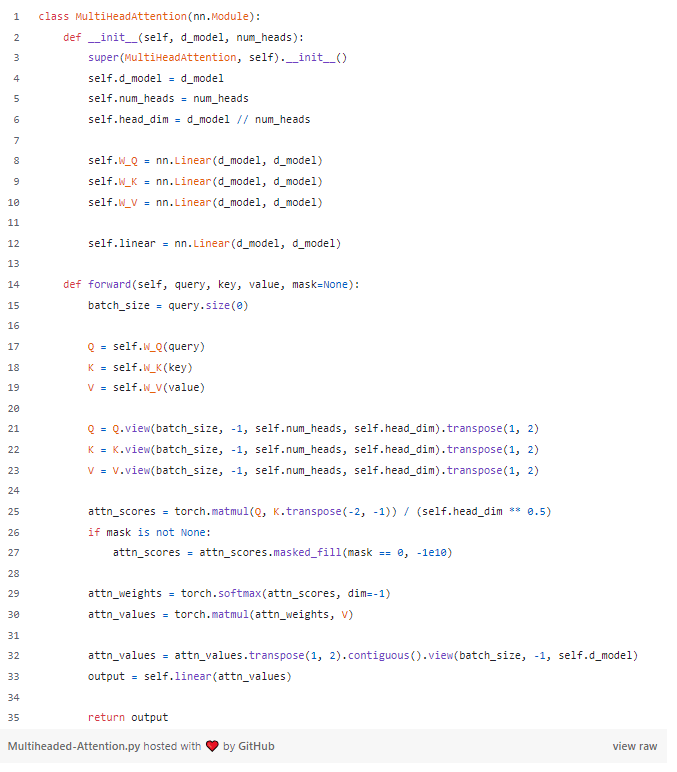
In this code, the variable d_model stands for the
dimensionality of the embedding we use to convert text into vectors.
Conclusion
As we have looked at the basic building blocks of transformer models, we got a good undestanding about the working of them in detail.