Where the AI Jobs Actually Are: A Sector-by-Sector Map for 2026
The best AI job for you may be in the industry you already understand, not the industry getting the most headlines. Banks need fraud detection, hospitals need better documentation, and retailers need smarter inventory and customer support systems.
For career switchers, that matters. Employers are not only looking for people who understand AI models; they also need engineers who understand the business problems those models must solve.
1. Healthcare and Financial Services: Accuracy Matters
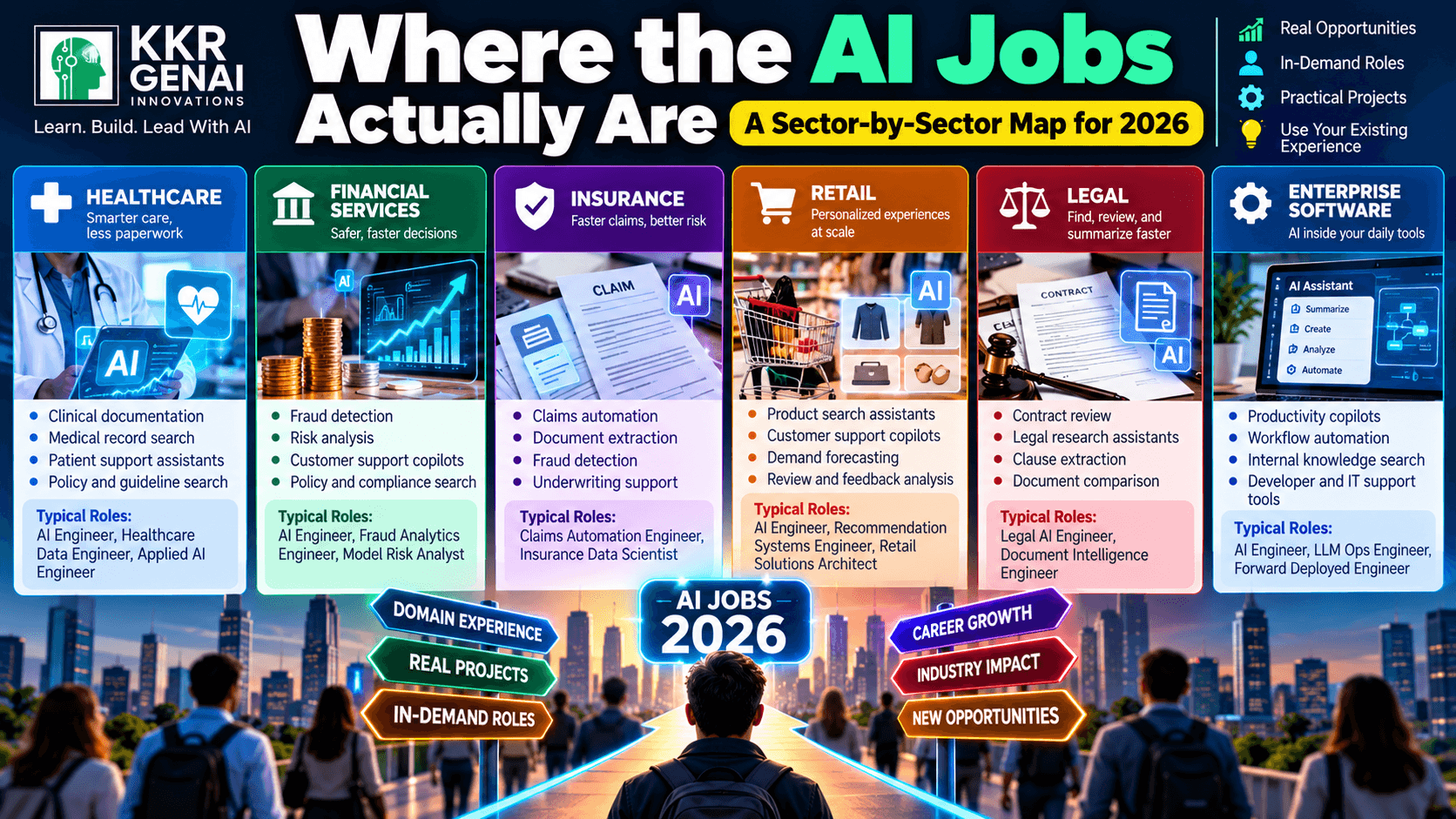
Healthcare: The problem is paperwork, information access, and workflow efficiency. Hospitals and healthcare companies are exploring AI tools that summarize clinical notes, draft documentation, search medical policies, organize patient messages, and reduce administrative work. The American Hospital Association identifies administrative, financial, operational, and clinical applications as major areas for healthcare AI.
Typical roles include AI Engineer, Healthcare Data Engineer, Applied AI Engineer, and Clinical AI Solutions Architect. Projects may combine speech transcription, document extraction, retrieval-augmented generation (RAG), and integrations with electronic health record systems. Skills in Python, SQL, APIs, data security, and healthcare terminology provide an advantage.
If you already work in healthcare IT, billing, claims, or medical data, your domain knowledge is valuable. You understand the workflows and the consequences of incorrect information; AI systems still need clinical oversight, privacy safeguards, and reliable evaluation.
Financial services: The problem is risk, fraud, and employee productivity. Banks invest in systems that flag suspicious transactions, summarize customer interactions, search internal policies, support analysts, and help employees investigate complex cases. The US Government Accountability Office identifies customer service, credit decisions, and trading among financial services AI applications.
Typical roles include AI Engineer, Fraud Analytics Engineer, Model Risk Analyst, and AI Solutions Architect. Python, SQL, transaction data, identity controls, audit trails, and model evaluation are useful skills. Experience in banking operations, payments, compliance, or financial data can be a stronger starting point than general AI knowledge alone.
2. Insurance and Retail: Decisions at Scale
Insurance: The problem is processing claims and assessing risk. Insurers use or explore AI for claims document extraction, damage-image analysis, fraud detection, underwriting support, and customer communications. A European insurance-sector survey published by EIOPA in 2025 found that 40% of surveyed undertakings reported using generative AI in customer service and 32% in claims management.
Potential roles include Claims Automation Engineer, Insurance Data Scientist, AI Engineer, and Underwriting Technology Specialist. Projects might extract information from claim forms, compare documents against policy conditions, or help adjusters identify missing evidence. Experience in claims, underwriting, actuarial work, or insurance QA provides useful domain context.
Retail: The problem is matching customer demand with available products. Retailers are building product-search assistants, customer service copilots, demand-forecasting systems, recommendation engines, and tools that summarize product reviews. Some projects combine traditional machine learning with LLMs rather than using generative AI for everything.
Typical roles include AI Engineer, Recommendation Systems Engineer, Data Engineer, and Retail Solutions Architect. Learn SQL, Python, forecasting basics, product catalogs, inventory systems, and APIs. If you have experience with Salesforce Commerce Cloud, CRM platforms, order management, or customer support, you already understand parts of the problem.
3. Legal and Enterprise Software: Knowledge Becomes the Product
Legal: The problem is finding and checking information across large document collections. Law firms and legal departments are exploring contract review, clause extraction, legal research assistance, document comparison, and matter summarization. These applications need traceable sources because a plausible but incorrect legal statement can create serious problems.
Typical roles include Legal AI Engineer, Document Intelligence Engineer, and Applied AI Engineer. Projects often involve RAG, OCR, document parsing, access controls, and citation validation. Legal operations, contract management, compliance, and document-processing experience can provide an edge, even if you are not a lawyer.
Enterprise software: The problem is connecting AI to real business workflows. Software companies are adding AI assistants and task-specific agents to CRM, IT service management, developer tools, and productivity applications. Gartner forecast in August 2025 that 40% of enterprise applications would include task-specific AI agents by the end of 2026, up from less than 5% in 2025; this is a forecast, not a confirmed outcome.
Typical roles include AI Engineer, LLM Ops Engineer, Forward Deployed Engineer, and AI Solutions Architect. Funded projects may connect an AI assistant to approved business records, automate ticket classification, summarize support cases, or help developers investigate code. Skills in APIs, Python, authentication, databases, Docker, and system integration are valuable.
4. Which Industry Gives Career Switchers the Biggest Advantage?
The strongest starting point is often the sector where you already understand the data and workflows. Salesforce professionals can target enterprise software, CRM automation, and retail technology; data engineers can explore healthcare analytics, financial data, insurance pipelines, or enterprise RAG systems.
QA professionals can specialize in AI evaluation, regulated workflows, and model testing. Technical support professionals can build knowledge assistants, ticket-triage systems, and service-desk copilots because they understand the questions users ask and the failure points that matter.
Choose one industry and build a project around a specific problem. For example, create a policy-search assistant using Python, FastAPI, and PostgreSQL with pgvector; include source citations, access controls, and a test set of 50 questions. Measure retrieval quality and answer correctness rather than simply claiming that the chatbot works.
AI opportunities exist across all six sectors, but hiring depends on budgets, company priorities, location, and experience. Research current job postings and look for repeated responsibilities before choosing a learning path.
Which industry do you want to build in — and do you already have domain experience there?
Join the KKRGENAI Innovations community discussion to share your target industry, compare project ideas, and learn from professionals building their next AI career.